
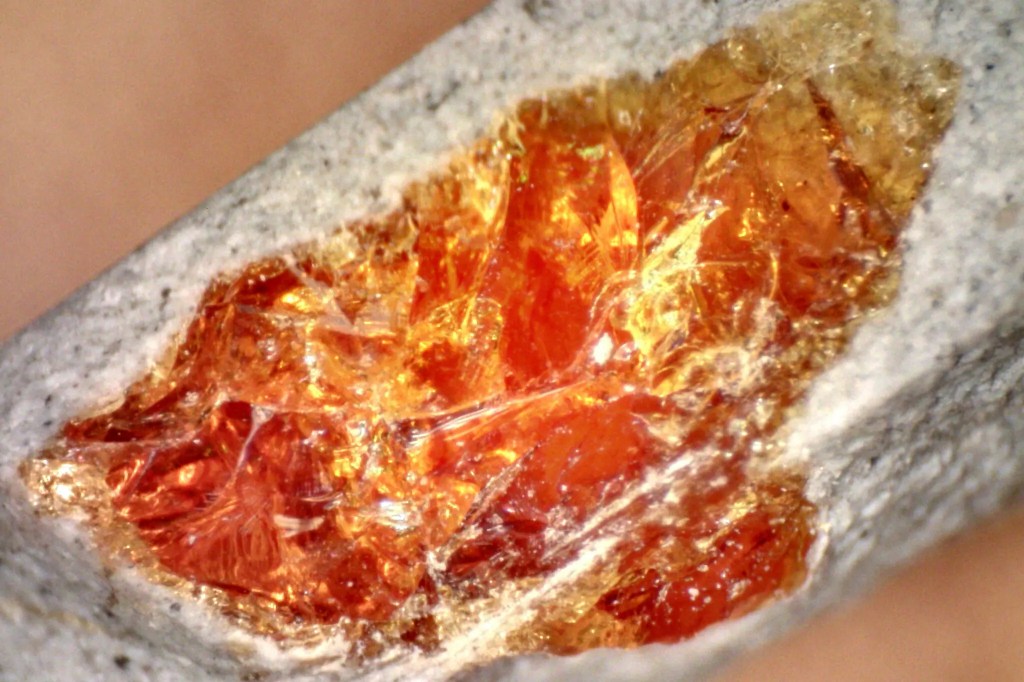
‘Synthetic Amber’
Artificial maturation using heat and pressure within compacted sediment can transform modern tree resin into substances resembling ancient copal and amber. Similarities span optical (including infrared spectroscopy) and physical properties. These experiments will improve the study of how amber fossilizes.
Study: Saitta & Kaye 2025, Scientific Reports
Media: New York Times, MIT Technology Review (German), Der Spiegel (German), News-O-Matic (for kids), brief mention in Science
Podcast: The Best of Our Knowledge
‘Synthetic fossils’ are chemically comparable to real fossils
Feathers undergoing high-heat, high-pressure experiments in sediment to simulate fossilization are chemically comparable to fossil feathers when studied with mass spectrometry. Both consist of dark stains produced by surviving, altered melanin pigment.
Study: Roy, Pittman, Kaye, & Saitta 2023, Paleobiology


‘Synthetic fossils’, a new experimental method
By compacting modern tissues in sediment and then ‘pressure cooking’ them to simulate long-term burial during fossilization, one can produce samples that are macro- and microscopically comparable to organically preserved fossils down to the level of an electron microscope.
Study: Saitta et al. 2018, Palaeontology
Press Releases: University of Bristol, Field Museum
Media: Science, Smithsonian Magazine, Earth Magazine, Discover Magazine, Popular Science, Atlas Obscura, BBC Future
Podcast: Briefly discussed by my collaborators on Palaeocast
Feathers do not clump together during compaction
Contrary to earlier experiments using a simple press, when sub-aqueously buried before compaction, feathers on bird carcasses do not appear to significantly clump together. Feathers in compression fossils can be interpreted without mistaking them for more primitive structures due to compaction.
Study: Saitta et al. 2018, PalZ


Dinosaur blood? Self-organizing structures
Claims of dinosaur blood cells are challenged by experiments examining microbial decay and thermal degradation of bird and reptile skin structures. Turkey scales and associated skin that were partially degraded inadvertently produced the same range of folded structures as seen in the dinosaur fossil when examined under the vacuum of an electron microscope. The dinosaur structures are possibly degraded, folded organic material from infiltrating microbes rather than original organics, let alone preserved blood cell structures.
Study: Saitta et al. 2017, Palaios
Press Release: University of Bristol
My Summary: The Conversation
Keratin protein does not fossilize
Feathers placed through high pressure, high temperature ‘artificial maturation’ to simulate deep burial and geothermal heat over millions of years degrade into a thick, smelly fluid that is water soluble at elevated temperature and not found in fossils. Other components of keratinous structures, such as pigments or calcium phosphates, can persist while proteins are lost from the fossils.
Study: Saitta et al. 2017, Palaeontology


 Evan T. Saitta, Ph.D.