Baby tyrannosaurs
Fossils of hatchling tyrannosaurs were relatively small, and clutches were likely large compared to size-scaling trends of modern birds, although not to the degree of modern reptiles. Their bone tissue was remodeled and teeth worn, suggesting precocial offspring with fairly limited parental care. Their growth rate was likely above those of crocodilians, but lower than modern birds and mammals. Overall, their reproductive strategy was intermediate between reptiles and birds.
Study: Longrich, Makovicky, Tokaryk, Cooper, Saitta, Erickson, Szekely, & Snively 2026, Biology (Cover Story)
Press Release: Oklahoma State University
Media: Nature Podcast, Discover, Gizmodo, IFLScience, Science Alert, Science & Vie (French), FOCUS Online (German), Geopop (Italian), elDiario.es (Spanish), Infobae (Spanish), Times of India, Phys.org, CNN Greece (Greek), FOX Weather, Naked Science (Russian), Olhar Digital (Portuguese), Descopera (Romanian)
Art: Raul Martin

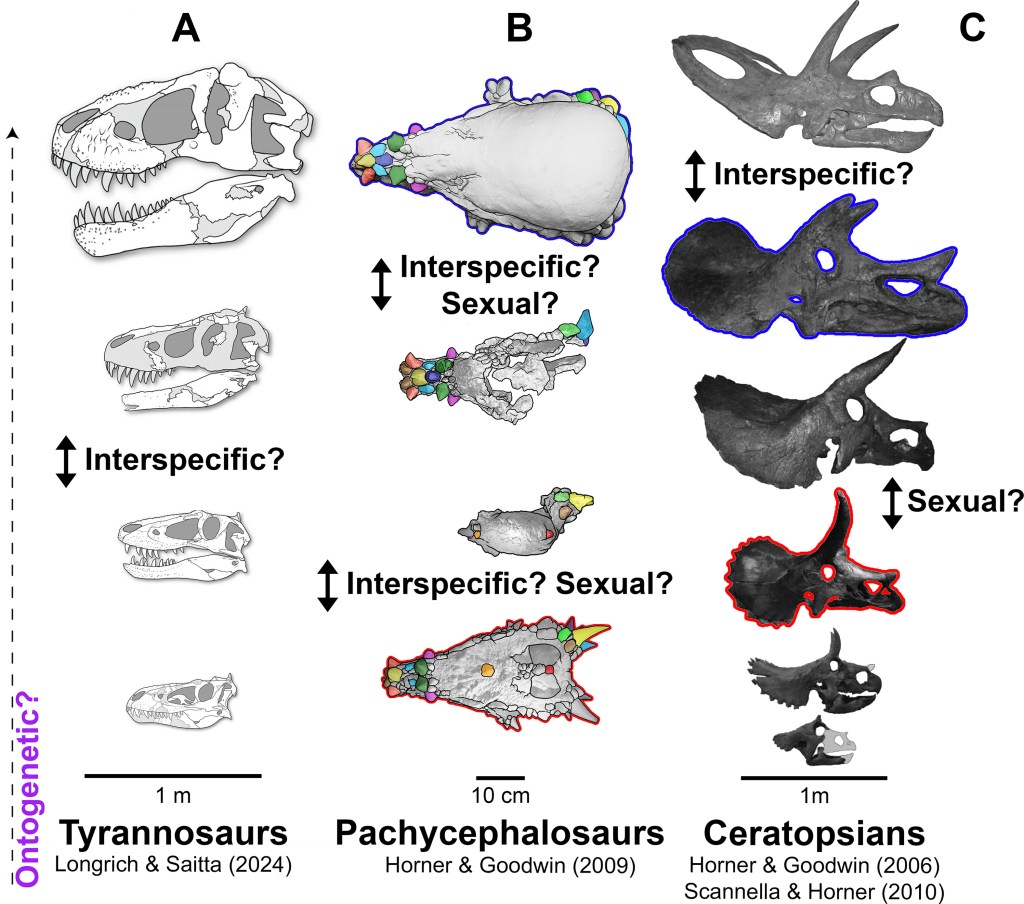
Intra- & inter-species variation in dinosaur growth
Models of dinosaur growth can overlook key variables. A growth-only bias may appear in the analysis and presentation of data itself. Recent work shows growth models can contradict evidence of inter-species variation. Sexual differences are also an underappreciated form of dinosaur variation.
Study: Saitta 2026, Cretaceous Research
Media: Briefly discussed on I Know Dino
Built with Claude AI
Lessons from the ‘replication crisis’ in science
Simulated data show that effect-size statistical approaches, rather than significance testing, are more reliable when searching for sexual dimorphism in the fossil record. Dinosaurs show many lines of evidence for sexual variation.
Study: Saitta et al. 2020, Biological Journal of the Linnean Society (Invited Review)
Press Release: Field Museum
Media: Discover Magazine, briefly discussed in Cosmos
My Summary: The Conversation
Presentation: Palaeontological Association, 2017

Independent reproducibility of Saitta (2015):
Dimorphism can be established in at least three species of dinosaurs and a sauropterygian, namely Allosaurus fragilis, Hesperosaurus mjosi, Protoceratops andrewsi, and Keichousaurus hui” – Motani (2021)

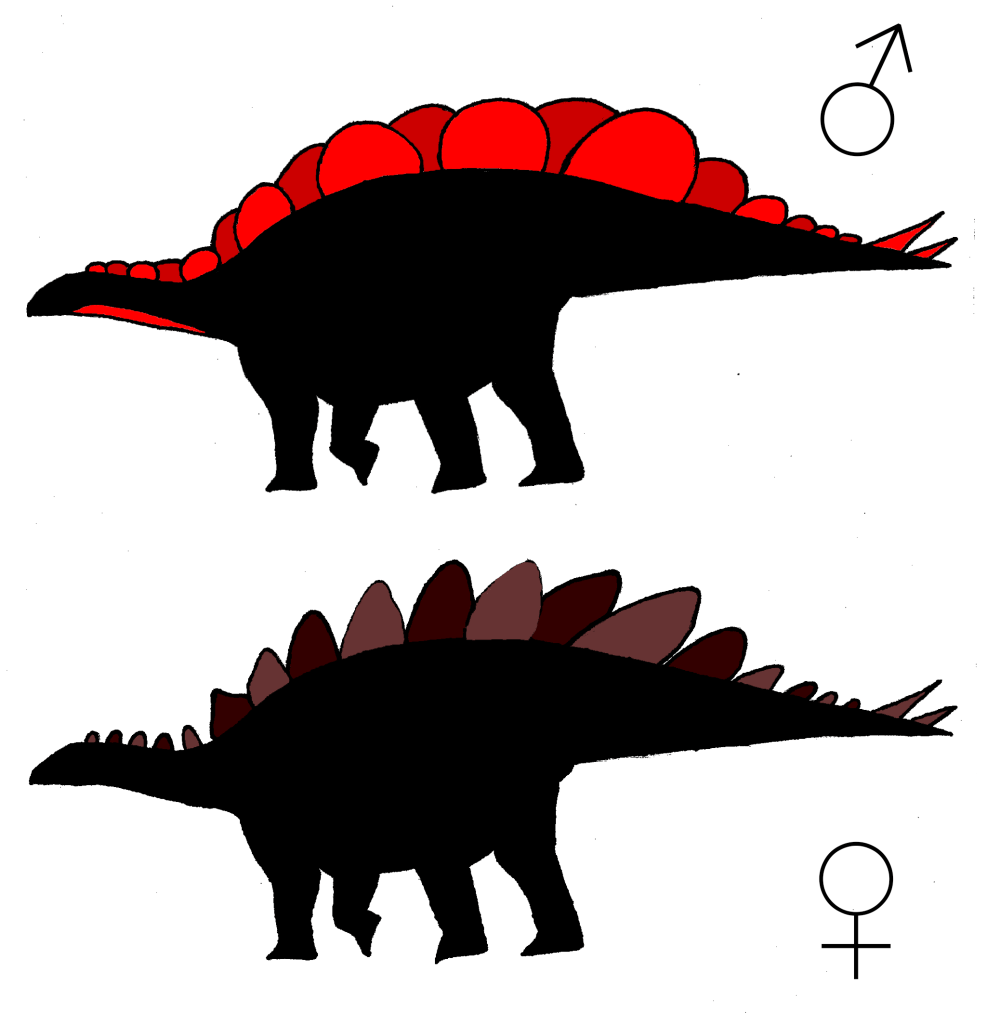
Stegosaur plate variation likely correlates with sex
Hesperosaurus mjosi plates show variation between wide and narrow varieties that cannot be solely explained by factors such as growth/development, ‘hidden’ species, or head-to-tail variation and is, therefore, consistent with sexual dimorphism.
Study: Saitta 2015, PLoS One
Press Release: University of Bristol
Media: BBC, The Guardian, Los Angeles Times, Popular Science, The Economist, Vice, NBC News, ABC News, IFLScience, International Business Times, Live Science, World Science Festival, Der Spiegel (German), The Naked Scientists, Princeton University, briefly discussed on I Know Dino (Episode 38 “Stegosaurus“ & Episode 50 “Hesperosaurus“) & PBS Eons, featured by Vladimír Socha, Martina Ležáková, & editors of ABC magazine (2022) Dinosauři Czech News Center (Czech), briefly discussed by Joël Ignasse (2025) Sur les traces du nouveau T. rex Eyrolles (French)
Presentation: Palaeontological Association, 2015